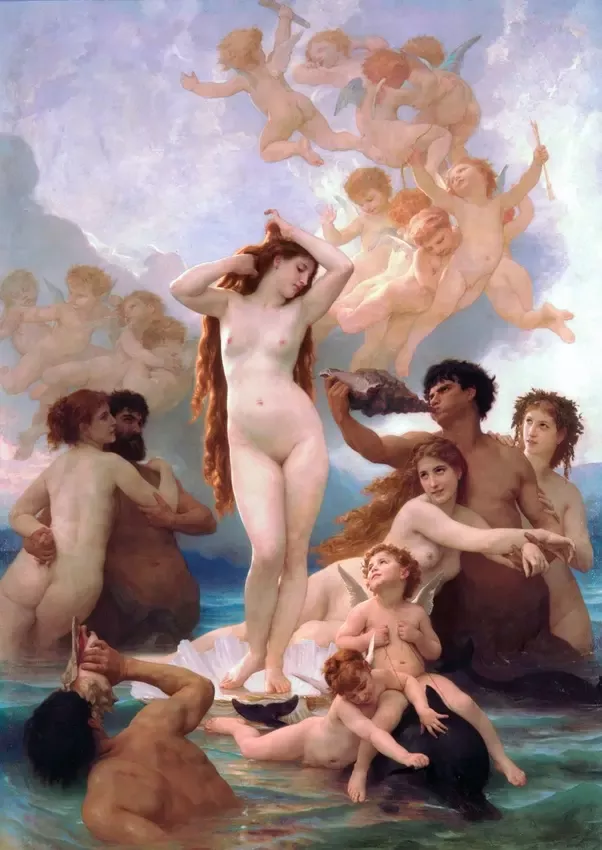
Art reached a peak of technique and realism in the 1800s that was often used to portray idealized female specimens devoid of challenging elements. Bouguereau’s Birth of Venus is a good example.
Our response to these works is, “Wow, that’s beautiful.”
This is followed by, “It’s impressive that artists can do that! Incredible.”
The Birth of Venus by William-Adolphe Bouguereau. Public domain.
You aren’t thrown by any brushstrokes, there are no deliberate shifts in style to direct your eye from the obvious focal point. The poses explicitly welcome the lust of the observer, giving it sanction and reassuring us that it’s okay to stare.
We’re invited to enjoy the feast.
Work of this nature was confronted by a few different movements, most of which sought to depict subjects that were less beautiful and less perfect in ways that were more unsettling to the viewer. Manet’s Olympia was a notable offering in this vein.
Olympia is not idealized, and she’s not especially happy to see you. Unlike the painting above, where the woman is a perfect offering waiting for your delectation, here we see an active challenge in the subject’s gaze. She isn’t turning you away, you’re perfectly welcome, but she’s clearly busy and you’d better get on with it.
Olympia by Edouard Manet. Public domain.
This woman, unlike Venus above, is human. She has her own needs, her own desires, her own plans. She may offer you her body, but even as she gives of herself, she remains her own.
Olympia is a prostitute, not a goddess, but she covers her moneymaker with a hand that’s more sharply detailed and defined than the rest of the painting. Her hand isn’t there to placate art censors, it is a deliberate focal point.
She is keeping you out, not offering herself. She is a real person, not a prurient daydream.
New, less beautiful subjects challenged viewers. So did stylistic changes. Shifts from beauty and perfect replication of what we see and dream developed to encourage a response in the viewer.
The Blue Room by Paul Ranson. Public domain.
Soon, we were encouraged to look at the level of definition, the framing and colors, the shapes utilized and displayed. Every choice is deliberate, not mere pandering to our expectations, and we are encouraged to ask why those choices were made.
How these choices make us feel also becomes salient. While Bouguereau and his ilk pandered to our desires, these artists are doing something else. Space is thereby created for us to contemplate what they have done to us, since they aren’t merely aiming to seduce us.
What do we feel when we look at these paintings? How do we respond?
That’s the point.